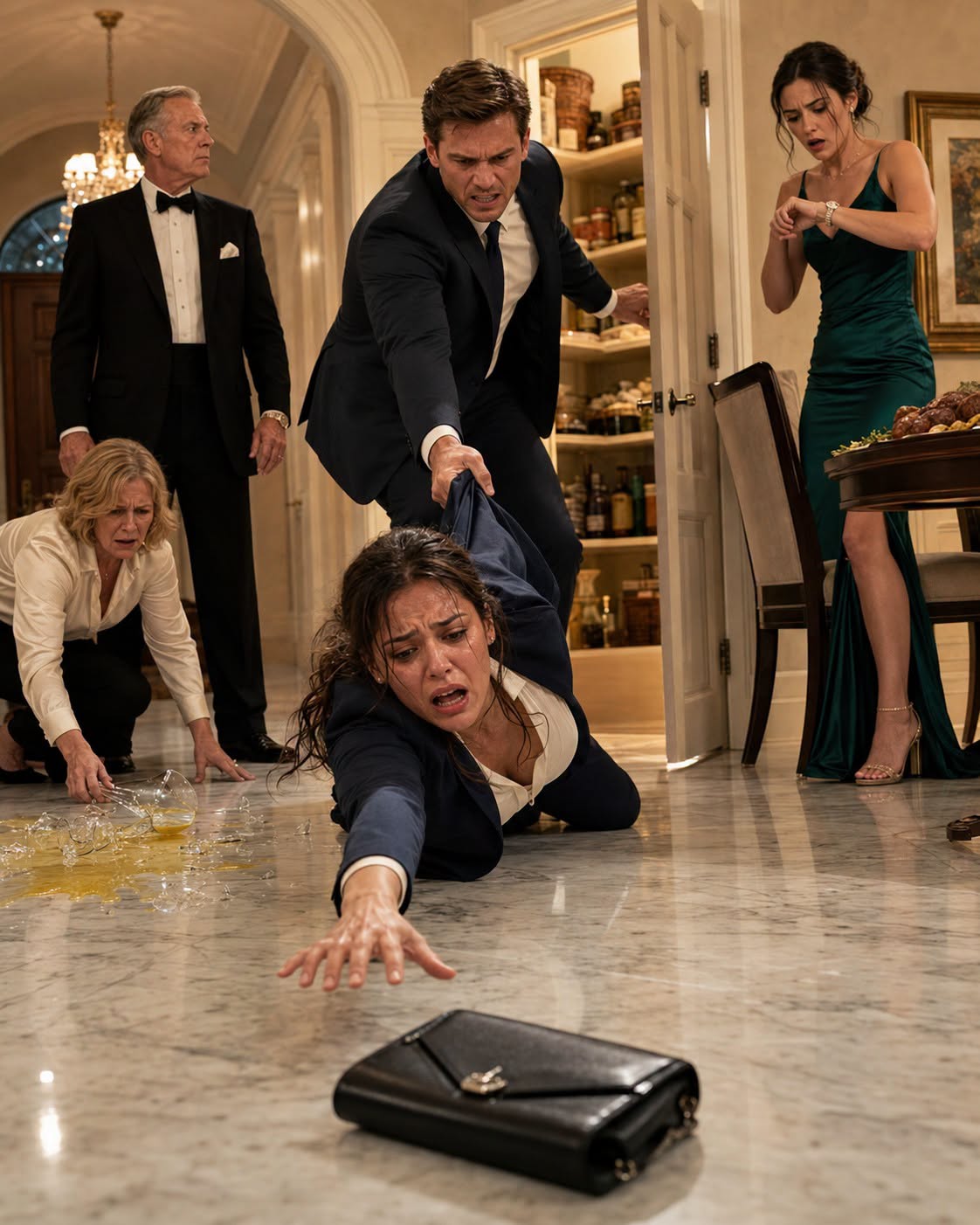
The cable hit the floor before the television went black.

One second I was listening to a quiet documentary about the Pacific campaign, the kind of program Catherine and I used to watch together on rainy evenings. The next second my son-in-law Jason stood beside the entertainment center with the cable dangling from his fist like a trophy.
“Enough,” he said. “This house needs better standards.”
He did not ask. He never asked anymore.
He announced.
Jason Caldwell had been living under my roof for eighteen months with my daughter Kinsley. They had lost their apartment, or so they told me. Catherine had been gone five years by then, and loneliness makes a man generous in ways he later calls foolish. I opened the door because Kinsley was my only child. I told myself it was temporary. I told myself family was allowed to be inconvenient.
But inconvenience had become occupation.
Jason parked where he wanted. He took over my old study. He answered my doorbell. He started calling me Joe instead of Dad or Mr. Brennan, as if stripping the title from me also stripped the house from my name.
What broke me was not the cable.
It was Kinsley.
She came home in her blue scrubs, saw the dead television, saw me holding the broken end in my palm, and waited just long enough for hope to rise in me.
Then she said, “Mom would be ashamed of how you spend your time. Jason is right.”
I did not answer. If I had spoken then, I would have begged, and a father should not have to beg his daughter to remember him.
I went upstairs with the broken cable and placed it on my desk beside a yellow legal pad. For forty-two years, I had worked as an investigative journalist. I had built stories from bank records, public filings, whispered tips, and one detail everyone else dismissed. Grief had softened me. Fear of losing Kinsley had made me quiet. But quiet was not the same as helpless.
At midnight, I wrote the date at the top of the page.
Then I wrote: start being a journalist again.
Jason’s laptop sat open in the room he had stolen from my bookshelves. No password. No lock. That arrogance was almost funny, but my hands were too steady for laughter. I photographed everything I found.
The credit card statements came first. Restaurants I had never entered. Hotels I had never booked. Clothes I had never worn. My signature appeared at the bottom of the receipts, close enough to pass a sleepy glance, wrong enough to offend the man who had written that name for sixty-seven years.
Then came the emails.
Jason had contacted Sunrise Meadows Memory Care and described me as confused, difficult, unsafe. He had asked about paperwork. He had filled in my full name, birth date, and Social Security number on a preliminary application. In one message, he wrote that once power of attorney transferred, the house could be sold within ninety days.
I read that line three times.
The house could be sold.
Not our home.
Not Joe’s house.
The house.
An asset. A prize. A thing to liquidate after the old man was put away.
By three in the morning, I had six copies of the evidence. Phone. Laptop. Cloud drive. Two USB drives. One encrypted file sent to Charles Norton, the lawyer who had helped me survive half the dangerous stories of my career. At dawn, Charles called me back and did not waste a word.
“Do not confront him alone,” he said. “Secure the house. Secure the bank. Then we move.”
So I moved.
The bank froze the card and opened a fraud case. A branch manager placed the report in my hand with the careful sympathy people reserve for betrayal by family. A locksmith named Tony changed every deadbolt in the house. I packed Jason and Kinsley’s belongings into four blue suitcases, and when I reached Kinsley’s cardigan, the cream one she wore last Christmas, I had to sit on the bed until my hands stopped shaking.
I loved my daughter.
That was never the question.
The question was whether love required me to disappear quietly so her husband could feel powerful.
At 6:07 that Monday evening, Jason’s key failed in the front door.
I heard the scrape. The pause. The second try.
Then Kinsley’s key failed too.
Jason circled the house, trying the back door, the garage, even the basement window. Every lock held. When he returned to the porch, he pounded hard enough to rattle the frame.
“Open this door!” he shouted. “This is my house too!”
I stood in the hall for a moment and looked at the four suitcases. Then I opened the door six inches, chain fastened.
Kinsley stood behind him, pale and confused.
Jason was red with fury.
“What did you do?” he demanded.
I held up the deed first. Then the bank report. Then the emails.
“You were a guest,” I said. “Past tense.”
He called me senile. He told Kinsley I was making connections that did not exist. Then I slid one printed email through the gap, and my daughter picked it up with shaking hands.
Her face changed while she read.
“Jason,” she whispered. “This is real.”
He made the mistake angry men make when the mask slips. He told the truth because he thought volume could turn it into authority.
“That money was going to be ours anyway,” he snapped. “When he died. When the house sold. We were just speeding things up.”
The street went silent.
Even the neighbors heard it.
Jason called the police himself. He said I was having an episode. Officer Reynolds arrived expecting an old man in crisis and found a retired journalist with a deed, forged signatures, emails, and a fraud report laid out on the coffee table.
After he reviewed the papers, he stepped back onto the porch.
“Mr. Caldwell,” he said, “you need to leave this property now.”
That should have been the end.
It was not.
Jason carried the suitcases to his truck with half the block watching. Kinsley followed him, crying, still choosing his shadow over my doorway. I let her go because dragging her back by guilt would only make me another man trying to control her.
Three nights later, Jason returned drunk and broke my living room window with a bat. He smashed the mailbox Catherine and I had installed in 1997. He spray-painted the garage while I recorded from upstairs and called 911. Reynolds arrested him in my driveway, still shouting that I had stolen everything from him.
By morning, Kinsley had posted his bail.
That hurt worse than the broken glass.
I called her once. She told me Jason was under pressure. She told me I had ruined his life. She told me to leave them alone.
Every sentence sounded like a warning sign from an interview I had done twenty years earlier with a woman who defended the man who kept hurting her. I recognized the script. I hated recognizing it from my own daughter’s mouth.
I did the only thing I could do.
I left the door open in one direction.
Barbara Peterson across the street had my number. Charles had the legal case moving. I knew where Jason had taken her: Oak Towers, a weekly rental building on the east side where the hallway lights flickered and no one asked many questions if rent was paid in cash.
For three days, my phone did not ring.
On the third night, it did.
“Dad,” Kinsley whispered. “Help me, please.”
There are sounds a parent hears once and never forgets. Her voice was one of them. It was small, airless, broken around the edges. Behind her, Jason was yelling. Something heavy hit a wall.
“Where are you?” I asked.
“Bathroom,” she said. “Oak Towers. Apartment 3B. He smashed my phone, but Mrs. Cooper next door gave me hers. He is trying to get in.”
I was already in the truck.
“Keep the door locked. I am coming.”
The line filled with pounding. Then wood cracked. Kinsley screamed, and the call died.
I called 911 while running every red light between my house and Oak Street. The dispatcher told me to wait outside for officers. I told her I was her father and hung up before she could repeat herself.
The building door was unlocked. I took the stairs two at a time, which is not a sensible thing for a sixty-seven-year-old man with bad knees to do, but fear is its own engine. On the third floor, a woman in a faded robe pointed with trembling fingers.
“Three B,” she said. “Please hurry.”
I pounded on the apartment door.
Jason opened it with his body wedged in the gap. His eyes were glassy. His shirt was untucked. He smiled as if smiling could put the room back together behind him.
“Joe,” he said. “This is between me and my wife.”
I looked past his shoulder.
The lamp was shattered. A chair lay on its side. Kinsley sat near the bathroom door, knees drawn to her chest, one wrist clutched against her body. When she saw me, her face collapsed with relief and shame at the same time.
“Come to me,” I said.
She tried to stand.
Jason shifted to block her.
Something in me went very still.
I had spent my career facing men who thought intimidation was a language everyone understood. Maybe it was. But there is another language they never learn: the silence of someone who has already decided.
I stepped forward.
Jason grabbed my arm. I broke his grip and moved past him, not because I was stronger, but because he had expected fear and found a father instead.
The stairwell thundered.
Officer Reynolds came through the hallway with Officer Davis behind him.
Jason changed instantly. Rage became innocence. His voice went high and wounded.
“He broke in,” Jason said. “He attacked me. Ask her.”
Reynolds did not look at him first. He crouched in front of Kinsley.
“Ma’am,” he said, “did he hurt you?”
Kinsley looked at Jason.
Then she looked at me.
I did not nod. I did not plead. I just stayed there, where she could see me.
“Yes,” she said.
One word.
The whole room changed.
Davis cuffed Jason while he shouted that she was lying, that she was confused, that wives made things dramatic. Reynolds called for paramedics. Mrs. Cooper stood in the hallway crying into both hands.
When Jason was dragged past me, he hissed, “She’ll come back. She always does.”
Kinsley flinched.
I wanted to say something sharp. Something final. Instead I went to my daughter, lowered myself beside her, and held out my hand.
She fell into my arms and sobbed like the sound had been locked inside her for years.
“I am sorry,” she kept saying. “I should have believed you.”
I held her tighter.
“You called me,” I said. “That is what matters.”
The months after that did not heal us quickly. Real healing is not a door that swings open because the villain is gone. It is paperwork. Court dates. Nightmares. Therapy appointments. Silence at breakfast because neither person knows which memory is safe to mention.
Jason took a plea deal in December after the fraud evidence, the vandalism video, Mrs. Cooper’s statement, and Kinsley’s report left him with very little room to perform innocence. Eighteen months in county jail. Five years of probation. Restitution ordered. Mandatory counseling he would probably resent every minute of.
Kinsley filed for divorce in January.
The night it was finalized, she came to my kitchen with swollen eyes and no wedding ring. She did not ask to move back forever. She asked if she could sleep under my roof one more week while she learned how to stop being afraid of quiet.
She stayed six weeks.
During that time, I learned things fathers do not want to learn. I learned that my strong daughter had been trained to apologize for another person’s rage. I learned that every time I thought she was choosing Jason over me, she was also trying to survive the story he had built around her. I learned that being right does not feel good when someone you love had to get hurt before they could see it.
In February, Kinsley found a small apartment near the hospital. Safe building. Good locks. A neighbor with a loud laugh and a little dog that barked at everyone. When she showed me pictures, she watched my face like she expected disappointment.
“I need to know I can live alone,” she said.
“Then I will help you move,” I said.
We both cried in the parking lot after the last box went upstairs.
Four months after Jason ripped that cable from my wall, my house sounds different.
Every Wednesday afternoon, twelve people sit in borrowed chairs in my living room. Barbara Peterson comes. Arthur Coleman comes. So do widows, veterans, retired teachers, and one man whose grandson emptied his savings account before anyone believed him. We talk about warning signs. We talk about shame. We talk about how hard it is to admit that love and danger can wear the same familiar face.
Kinsley visits twice a week now. Sometimes she brings Chinese takeout. Sometimes she just sits in Catherine’s chair and tells me about work. Last Wednesday, she set down her chopsticks and said, “Thank you for not giving up on me when I had given up on myself.”
I told her the truth.
“I never stopped being your father. I just had to remember I was still a person too.”
After she left, I opened the side table drawer. Inside is a small box. Inside the box is the black cable Jason ripped from the wall.
I keep it not because I need the anger.
I keep it because I need the reminder.
Dignity is not something other people hand back when they are done taking it. Sometimes you have to claim it with shaking hands. Sometimes you have to lock your own door. Sometimes you have to become the bad guy in someone’s version of the story long enough for the truth to survive.
My house is quiet now.
Not empty.
Quiet.
There is a difference.
Catherine’s photo is still on the mantel. Kinsley’s new apartment key is on my emergency ring. The support group chairs are stacked in the dining room, ready for next Wednesday.
And when I sit down with a documentary at night, the cable stays firmly in the wall.