Part 2
Caleb Rowan had never known a hospital corridor could feel so endless.
It stretched in both directions beneath cold white lights, polished floors shining like still water, every footstep magnified until even the quiet seemed to have weight. Somewhere beyond the double doors, people were fighting to save his wife and child. Somewhere beyond those doors, Hannah lay under bright surgical lamps after spending hours believing he had abandoned her.
And in Caleb’s hands was her phone.
The evidence pouch crinkled softly as his fingers tightened around it. The nurse who had handed it to him remained nearby, her expression carefully professional but not unkind. She had seen fear before. She had seen husbands go pale, mothers collapse into chairs, fathers bargain with silence. But Caleb understood from the way she looked at him that this was different.
This was not only fear.
This was the moment a man began to realize the danger had come from inside his own family.
“Mr. Rowan?” the nurse said gently.
Caleb lifted his eyes.
“Your wife was very clear before they took her back. She asked that you see the messages. She said, ‘He needs to know I tried.’”
The words struck him more sharply than any accusation could have.
He needs to know I tried.
Not he needs to know I was right. Not he needs to know what his mother did. Just that.
She had wanted him to know she had tried to reach him.
Caleb looked again at the photograph on Hannah’s phone.
Dr. Elias Morgan stood on the front steps of their townhouse, one hand holding his medical bag, his face turned slightly away as though he had just glanced toward the street. Nothing in the image was intimate. Nothing suggested secrecy. It looked like exactly what it was: a physician arriving at a patient’s home.
But Lorraine had framed it with seven words designed to poison the moment before Caleb ever walked through the door.
Do not return home yet. She is about to tell you everything.
There was no direct lie in the sentence. That was Lorraine’s specialty. She had built a life out of arranging truth in such a way that it performed the work of deception.
Caleb’s first instinct was to call her.
His thumb moved to the screen before he stopped himself.
For years, Lorraine had always known how to make him speak first. She turned questions into disloyalty, silence into guilt, disagreement into betrayal. If he called now, she would cry. She would say she had been frightened. She would say Hannah had sounded hysterical. She would say she had only tried to protect him from humiliation while he was traveling.
And Caleb, who had spent most of his life hoping that love meant never choosing sides, might once again find himself trapped inside his mother’s version of events.
So he did not call.
He sat down instead.
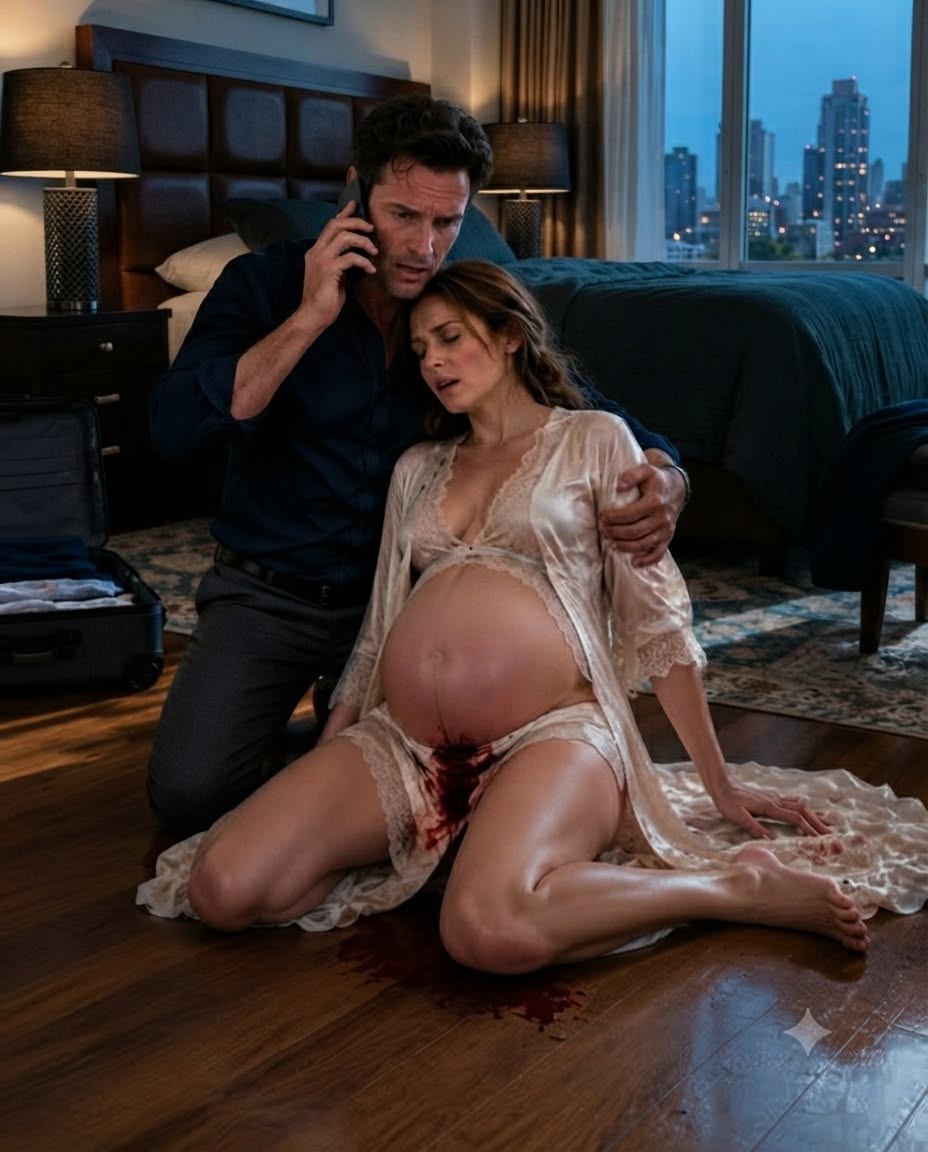
The chair beneath him was stiff and low. His shirt had dried in dark reddish patches, and when he lowered his hands, he noticed blood beneath his fingernails. Hannah’s blood. He curled his fingers inward.
A memory surfaced without warning.
Hannah, five months pregnant, standing in their kitchen with one hand resting against her lower back, trying to laugh as Lorraine rearranged the nursery shelf.
“She won’t like sleeping near the window,” Lorraine had said.
“We’re not sure she’s a girl,” Hannah replied.
Lorraine had smiled without turning around. “A mother knows.”
Hannah had looked at Caleb then, not angrily, but with quiet exhaustion. A look that asked him to notice how often his mother made a claim on things that were not hers.
He had kissed Hannah’s temple and said, “Mom’s just excited.”
How many times had he said that?
How many small wounds had he covered with the same useless bandage?
The double doors opened, and a doctor in surgical scrubs stepped out. Caleb stood so quickly the chair scraped backward.
“Mr. Rowan?”
“Yes.”
“I’m Dr. Patel. Your wife is in surgery. The baby is alive, but there has been significant bleeding. We believe it is a placental abruption. We are doing everything we can.”
Caleb felt the floor tilt.
“The baby is alive?”
“Yes,” Dr. Patel said. “But both of them are still at risk. We need to move quickly. Your wife lost a lot of blood.”
Caleb nodded, though he could barely feel his own body.
Dr. Patel’s expression softened a little. “There is one more thing. Your wife’s blood pressure dropped before surgery, but she was conscious long enough to tell us that she had been advised not to come in despite symptoms. We will document everything medically. Right now, the most important thing is stabilizing her.”
Caleb swallowed hard. “A doctor came to the house. Dr. Morgan.”
“Yes. He called ahead. He was very concerned. From what I understand, he came after speaking with your wife by phone and believed she needed emergency care.”
“He left his jacket.”
“That may have happened while trying to assist her,” Dr. Patel said. “He arrived separately and is speaking with hospital administration now.”
Caleb looked toward the corridor. “Can I talk to him?”
“Soon. Right now, wait here. I know that sounds impossible, but it is what you can do.”
The doctor returned through the doors, leaving Caleb with the terrible labor of waiting.
Minutes passed with no shape. A clock ticked above the nurses’ station, but time did not move normally. It gathered in his chest.
He listened to the murmur of nurses, the distant roll of carts, the soft ring of phones. Across from him, a young man in paint-stained work clothes held a plastic cup of coffee and stared at the floor. An older woman clutched a rosary. Life and fear existed side by side in that corridor, strangers bound by doors they could not enter.
Caleb pressed Hannah’s phone against his knee.
The nurse had given him permission to look through the recent messages because Hannah had specifically requested it, but he hesitated before opening anything else. Even now, after what had happened, privacy mattered. Hannah had been fighting to be believed. The least he could do was treat her trust carefully.
He opened only the message thread with Lorraine.
The first message was from Hannah at 9:14 a.m.
Lorraine, I can’t reach Caleb. I’m bleeding and having pain. I called the doctor. He says I should go to the hospital.
Lorraine replied three minutes later.
You need to calm down. Pregnancy has discomfort. You are always imagining the worst.
Hannah: This is not discomfort. I need help.
Lorraine: I will call the hospital and find out what they actually said. Do not embarrass yourself by making a scene.
Hannah: Please just come over.
Lorraine: I am coming. Lie down. Do not call an ambulance unless the doctor directly orders it.
Hannah: He did.
Lorraine: I will speak with him.
Caleb’s breath turned shallow.
Another message, sent ten minutes later.
Lorraine: I spoke with someone. They said you are stable. You are frightening yourself. I am taking your phone for a few minutes so you stop working yourself into a panic.
Hannah: Please don’t. I need Caleb.
There was a gap.
Then a message sent from Hannah’s phone to Caleb at 10:02 a.m.
Caleb, I’m sorry. I overreacted. Your mother is here. Symptoms stopped. Don’t rush home.
Caleb stared at it.
He had not seen it because his phone had been off on the flight. But Lorraine had sent it from Hannah’s phone. That much was obvious now. Hannah would never write that way while frightened. Hannah used full sentences when calm and fragments when scared. She would not say “symptoms stopped” like she was filling out a medical chart.
The next message from Lorraine, sent from her own phone, was the photograph of Dr. Morgan.
Caleb scrolled no farther. He could not.
A door opened at the far end of the hallway, and a man in a wrinkled dress shirt stepped through, carrying his suit jacket over one arm. He was in his late thirties, perhaps early forties, with tired eyes and a thin line of dried blood near his cuff.
Caleb recognized him from the identification card.
Dr. Elias Morgan paused when he saw Caleb.
“Mr. Rowan?”
Caleb nodded.
The doctor approached slowly, not like a man afraid of confrontation, but like one who understood the room was full of fragile things.
“I’m Elias Morgan. I wish we were meeting under different circumstances.”
Caleb looked at the jacket in his own hands. “This is yours.”
“Yes. Thank you.” Elias took it but did not put it on. “I left in a hurry.”
“What happened at my house?”
Elias glanced toward the surgical doors. “Your wife called the practice line this morning. Her regular physician is out of town, so the call routed to me. She described abdominal pain, bleeding, dizziness, and decreased fetal movement. I told her to call emergency services immediately and get to the hospital. She said she could not stand and could not reach you.”
Caleb gripped the back of the chair. “Why did you go there yourself?”
“Because she stayed on the phone too long trying to explain why she needed permission.” Elias’s voice remained even, but something tightened beneath it. “That concerned me. She sounded scared, but not confused. She understood the danger. Then the call disconnected. When I called back, a woman answered and said Hannah was resting and did not need assistance. She identified herself as family.”
“My mother.”
“I suspected as much later.” Elias looked down. “I told her Hannah needed urgent evaluation. She said Hannah had anxiety and often exaggerated symptoms. I asked to speak to Hannah again. She said Hannah was sleeping.”
“And you believed her?”
“No,” Elias said. “That is why I came.”
Caleb closed his eyes briefly.
Elias continued. “When I arrived, your mother was in the foyer. She was upset that I came without being invited. She said Hannah had changed her mind about going in. I insisted on seeing my patient. We argued. Not loudly, but enough that Hannah heard us. She called my name from upstairs.”
Caleb pictured Hannah alone in the bedroom, bleeding, trying to call for help while Lorraine stood between her and the doctor.
“My mother let you in?”
“She tried not to. I told her I would call emergency services from the porch and report that a pregnant patient with possible abruption was being prevented from receiving medical care. Then she moved.”
Caleb’s throat closed.
“When I reached Hannah, she was on the floor beside the bed,” Elias said. “There was blood on the sheets. She had tried to stand. She was holding a framed photograph, I think because it had fallen and broken. I started basic assessment and called ahead to Harbor Regional. Your mother followed us upstairs. She kept saying Hannah had caused a misunderstanding.”
“The jacket?”
“I took it off because the room was warm and because I needed to move quickly. Your mother was holding Hannah’s phone. I asked her to give it back. She refused at first. Then she said she was calling you.”
Caleb lifted his head. “She sent me a photograph of you.”
Elias’s expression changed—not surprise exactly, but recognition, as if he had been waiting for a missing piece to appear.
“That explains why she asked me to step outside.”
“What?”
“She said she was feeling faint and needed air. I was on the phone with the hospital, and Hannah was conscious. I stepped just beyond the bedroom doorway for a moment, then your mother said she needed to get something from downstairs. I saw her near the front window with Hannah’s phone, but I did not understand what she was doing.”
“She was setting a trap.”
Elias said nothing.
Caleb sank back into the chair. “I walked in and saw your jacket, the blood, the bed, the photograph. For a few seconds, I thought—”
He stopped. Shame filled the unfinished sentence.
Elias’s voice lowered. “Your wife asked for you the entire time.”
Caleb looked at him.
“She was afraid you would misunderstand. She kept saying, ‘He’ll believe her if she gets to him first.’ I did not know who she meant then.”
Caleb sat very still.
He’ll believe her if she gets to him first.
Hannah had known him too well.
The surgical doors opened again before Caleb could answer. Dr. Patel appeared, and both men turned toward her.
“Mr. Rowan,” she said, “your daughter has been delivered.”
For a moment, Caleb did not move.
His daughter.
The word entered him like light through a cracked wall.
“She is alive,” Dr. Patel continued. “She is premature and small, and she needs help breathing. The neonatal team has taken her to the NICU. Your wife is still in surgery. She remains critical, but she is fighting.”
Caleb covered his mouth with one hand.
A sound escaped him, halfway between a laugh and a sob. He had imagined the worst so completely that the word alive felt almost unbearable.
“Can I see the baby?”
“Soon. The NICU staff will come for you when they can. For now, Hannah still needs us.”
“Does she know?”
“She was under anesthesia by then,” Dr. Patel said gently. “She does not know yet.”
Caleb nodded, but his heart twisted.
Hannah had carried their child for eight months. She had painted the nursery trim herself because she said the pale green looked like “spring before it decides what to become.” She had folded tiny cotton socks into drawer dividers and placed one hand over her stomach whenever Caleb read aloud from the old children’s book his father had given him. And now their daughter had arrived into a room of strangers while Hannah slept beneath danger.
“What does she look like?” he asked.
Dr. Patel’s face softened. “Tiny. Determined.”
A tear slid down Caleb’s cheek before he could stop it.
“Like her mother,” he whispered.
Dr. Patel gave him a moment, then returned to surgery.
Elias stepped back. “I’ll be available if the hospital or you need my statement. I am sorry, Mr. Rowan.”
Caleb looked at him. “You came when nobody else did.”
“I did my job.”
“No.” Caleb shook his head. “You did more than that.”
Elias did not argue. Perhaps doctors learned not to reject gratitude when grief needed somewhere to place it.
After he left, Caleb stood alone again.
His daughter was alive.
His wife was in surgery.
His mother had lied.
Those three truths circled one another in his mind, impossible to arrange.
His phone buzzed.
For one sharp second, he thought it might be an update from the hospital. Then he saw the name on the screen.
Mother.
The phone vibrated against his palm until the call ended. A voicemail appeared.
Then another call.
He let it ring.
A text arrived.
Caleb, where are you? I came by the house and saw the ambulance. Call me immediately. I am worried sick.
Caleb stared at the message. The same hands that had typed those words had taken Hannah’s phone. The same woman asking where he was had photographed a doctor on his porch and shaped it into suspicion.
Another text.
Do not let Hannah make this worse than it is. She was confused and emotional. I tried to help.
Caleb’s jaw tightened.
A third message.
I know how this looks, but you must listen to me before speaking to anyone.
That one revealed more than the others.
She already knew how it looked.
Caleb typed one sentence, then deleted it. He typed another and deleted that too. Anything he said now would become material for her. Lorraine knew how to pull threads from emotion and weave them into defense.
Instead, he turned off message previews and placed the phone face down.
A nurse approached soon after. “Mr. Rowan? The NICU is ready for you to see your daughter for a few minutes.”
The world narrowed.
He followed her through a set of secured doors and into a quieter wing where the air seemed warmer and every sound was softened by intention. The NICU lights were dim, the machines steady and watchful. Inside clear incubators lay babies so small they seemed more like promises than people.
The nurse led him to the far corner.
“There she is.”
Caleb stopped.
His daughter lay beneath a knitted cap no bigger than his palm. Fine tubes helped her breathe. A tiny monitor wrapped around one foot, and her fingers were curled near her face as though she had been interrupted mid-dream. Her skin was flushed and delicate, her chest rising with the assistance of the machine.
Caleb stepped closer slowly, afraid the force of his love might disturb her.
“She weighs four pounds, one ounce,” the nurse said. “That is small, but not hopeless. She is receiving respiratory support, and the neonatologist will explain more soon.”
Caleb nodded without taking his eyes off the baby.
“Does she have a name?”
He and Hannah had not chosen one.
They had narrowed the list to three, then five, then somehow eight. Hannah liked names that sounded gentle but had strong meanings. Caleb kept suggesting family names until Hannah finally said, “Your mother has already claimed enough space in this baby’s life.”
At the time, he had smiled awkwardly and changed the subject.
Now he understood the sentence differently.
“No,” he said. “Not yet. Her mother needs to choose with me.”
The nurse smiled. “That is a good answer.”
Caleb placed his hand through the opening in the incubator at her instruction. He did not touch the baby at first. He simply held his finger near her hand.
After a moment, her tiny fingers shifted.
They brushed him.
Then, impossibly, they curled around the tip of his finger with a strength so small it broke him.
Caleb bowed his head.
“I’m here,” he whispered. “I am so sorry I wasn’t there before. But I’m here now.”
The baby slept on, unaware of apologies, unaware of grandmothers and lies and broken photographs. She knew only warmth, sound, breath, and the fragile beginning of life.
Behind Caleb, the NICU door opened and closed softly.
A familiar perfume moved into the room before the voice did.
“Caleb.”
He froze.
Lorraine Rowan stood near the entrance, dressed in cream linen, her silver-blonde hair pinned low at her neck. Her face was pale, but not from fear alone. She had the composed distress of a woman who had rehearsed how worried she should appear.
The nurse turned. “Only parents are allowed in this area right now.”
“I’m the grandmother,” Lorraine said, attempting a trembling smile.
“Parents only,” the nurse repeated.
Lorraine’s gaze moved past her to Caleb. “Please. I need to know if the baby is all right.”
Caleb withdrew his hand gently from the incubator and faced her.
For thirty-four years, he had seen his mother as a fixed point. Difficult, yes. Proud. Sometimes overbearing. But permanent in the way childhood makes parents permanent. Even after he became a husband, some part of him still reacted to her disappointment like a boy caught breaking a rule.
That boy was gone.
Not dramatically. Not all at once.
But as Caleb stood between Lorraine and his daughter, he felt something in him step forward that had been waiting years to exist.
“You need to leave,” he said.
Lorraine blinked. “Caleb, I know you’re upset. This has been frightening for everyone.”
“For Hannah most of all.”
“Yes, of course,” Lorraine said quickly. “Poor Hannah. She was so worked up, and I tried to keep her calm. You know how she can be when she panics.”
The nurse glanced at Caleb, then at Lorraine.
Caleb lowered his voice. “Not here.”
“I am only trying to explain.”
“Not here,” he repeated.
For the first time, Lorraine seemed to notice that explanation was not working.
Her eyes brightened. “I spent my morning trying to help your wife. She called me because she knew I would come.”
“She called you because I wasn’t answering.”
“And I came,” Lorraine said. “I dropped everything.”
“You took her phone.”
“She was frightening herself.”
“You told the doctor her symptoms stopped.”
“I told him she had calmed down.”
“You sent me a message from her phone.”
Lorraine’s face tightened.
The nurse stepped closer. “Mr. Rowan, would you like security?”
Lorraine looked offended. “Security? For a grandmother asking about her grandchild?”
Caleb felt anger rise, but beneath it was something steadier. He had shouted in his mind on the way here, imagined accusations, demanded answers. But now, standing beside the incubator, he understood that anger would only give Lorraine a storm to hide inside.
“No,” he said to the nurse. “Not yet.”
Then he looked at his mother. “You cannot see Hannah. You cannot see the baby. You cannot come to our house. You cannot speak for us to any doctor, nurse, relative, neighbor, or friend. Not today. Not tomorrow. Not until Hannah and I decide otherwise together.”
Lorraine stared at him as if he had begun speaking another language.
“Caleb, listen to yourself.”
“I am.”
“This is Hannah’s doing,” Lorraine whispered, stepping closer despite the nurse’s warning look. “She has waited for this. She wants you to cut me out. She always has.”
Caleb almost laughed, not because it was funny, but because the pattern was suddenly so visible. Hannah bleeding on a bedroom floor became Hannah plotting. A doctor providing care became an affair. A boundary became cruelty.
“No,” he said. “This is your doing.”
Lorraine’s mouth trembled. “I am your mother.”
“I know.”
“I raised you.”
“I know.”
“I protected you when your father left us with nothing.”
That old sentence.
The foundation stone of Lorraine’s power.
Caleb had heard it so often it had become family scripture. His father left. Lorraine survived. Caleb owed her loyalty because loyalty was the only thing she had not lost.
But standing there, he realized something he had never permitted himself to ask.
Had his father truly left the way Lorraine said?
The thought arrived and unsettled him.
Lorraine must have seen some shift in his face because her voice softened instantly. “Darling. You are exhausted. You have blood on your shirt. You are scared. Let me take care of this. Let me call the family. Let me speak to the doctors. You should not have to handle this alone.”
There it was.
Comfort as control.
Caleb looked through the glass at his daughter.
“I am not alone,” he said. “I have a wife.”
Lorraine’s eyes hardened so quickly that only someone who loved her would have recognized it.
Then she did something Caleb did not expect.
She stopped pretending.
“You are making a mistake,” she said quietly. “You do not know what that woman has kept from you.”
The nurse moved between them. “Ma’am, you need to leave now.”
Lorraine kept her eyes on Caleb. “Ask her about the money.”
Caleb did not answer.
“Ask Hannah,” Lorraine said, each word precise, “why she has been sending payments to a man named Samuel Whitaker for six months.”
The name meant nothing to Caleb.
Lorraine saw that and seemed almost relieved by his confusion. “She did not tell you? Of course she didn’t.”
“Leave,” Caleb said, though uncertainty had already opened a small door in him.
Lorraine stepped back, smoothing her sleeve. The performance returned to her face like a veil being lowered.
“I will go because this is not the place,” she said. “But when you are ready to hear the truth, you know where to find me.”
Security arrived before she reached the main corridor. She did not resist. She simply lifted her chin and walked away as though escorted exits had always been part of her dignity.
Caleb remained still long after she disappeared.
Samuel Whitaker.
The name echoed with no memory attached.
The nurse touched his arm lightly. “Are you all right?”
“No,” Caleb said honestly. “But I’m staying.”
She nodded, as if that was enough for now.
Hours passed before Hannah came out of surgery.
Dr. Patel found Caleb in the waiting room near midnight. The hospital had settled into its quieter rhythm, the daytime urgency replaced by the low hum of night staff and vending machines. Caleb stood as soon as he saw her.
“Hannah is stable,” the doctor said.
The words landed like mercy.
Caleb closed his eyes.
“She is still very weak,” Dr. Patel continued. “She required transfusions. We will monitor her closely in recovery, but she made it through surgery.”
Caleb pressed both hands over his face.
“And the baby?”
“Still in NICU. Fragile, but holding her own.”
He lowered his hands. “Can Hannah see her?”
“Not tonight. Tomorrow, if her condition allows, we may arrange a brief visit or bring photographs. She will wake gradually. She may be confused.”
“I need to be there.”
“You can sit with her once she is moved to recovery.”
When Caleb entered Hannah’s room, the first thing he noticed was how small she looked.
Hannah had always carried herself with quiet warmth, the kind that filled a room without demanding attention. Pregnancy had changed her shape but not her presence. In the nursery, in the kitchen, in the garden where she coaxed herbs through the humid South Carolina spring, she seemed anchored in life.
Now machines framed her bed. Her hair was tucked beneath a loose cap. Her face was pale, lips dry, lashes resting against bruised shadows. An IV line ran into one arm. Another monitor traced her heartbeat in soft green peaks.
Caleb approached carefully.
“Hannah,” he whispered.
She did not wake.
He sat beside her and took her hand.
Her fingers were cold.
“I saw her,” he said, though he knew she might not hear. “She’s tiny. She grabbed my finger. You would have cried. I did cry, obviously. You would have teased me later.”
His voice broke.
“I should have believed you faster. I should have seen what was happening before today. Not just today. All of it.”
The machines answered with steady beeps.
Caleb bowed his head over her hand.
“I’m sorry,” he whispered. “I am so sorry.”
Near dawn, Hannah stirred.
It was barely movement at first. A shift of her fingers. A breath that caught. Then her eyelids fluttered open.
For a moment, she looked at the ceiling without recognition.
“Hannah?” Caleb leaned forward. “I’m here.”
Her eyes moved toward him.
Fear crossed her face before understanding did.
“The baby,” she whispered.
“She’s alive.” Caleb said it quickly, clearly. “She’s in the NICU. She’s small and needs help breathing, but she’s alive.”
Hannah’s eyes filled instantly.
“A girl?”
“A girl.”
A fragile smile touched her mouth and vanished under exhaustion. “I knew it.”
Caleb laughed softly through tears. “Your record remains annoying.”
“Name?”
“Not without you.”
Her fingers tightened faintly around his. “Good.”
Silence settled, tender and uneasy.
Then Hannah’s eyes shifted to the bloodstained shirt he still wore beneath a hospital blanket someone had placed around his shoulders.
“You came home,” she said.
“Early.”
“I thought…” She swallowed with difficulty. “I thought she got to you first.”
Caleb felt the sentence like a hand closing around his heart.
“She tried.”
Hannah closed her eyes.
“I saw the messages,” he said. “The photograph. I spoke with Dr. Morgan. I know enough.”
Her eyes opened again, searching his face.
“Do you believe me?”
The question was quiet.
It should never have needed asking.
Caleb leaned closer. “Yes.”
Hannah looked at him for a long time, as if belief itself were something she had to inspect before trusting it.
“I called you seventeen times,” she whispered.
“I know.”
“I wasn’t angry you didn’t answer. I knew you were traveling. I just needed…” Her voice faded.
“I know.”
“She took my phone. She said if I kept calling people, they would think I was unstable. She said mothers lose babies when they make themselves hysterical.”
Caleb shut his eyes briefly, forcing himself to stay calm for Hannah’s sake.
“She told Dr. Morgan I was fine,” Hannah continued. “I could hear her. I tried to get up. I knocked the photograph off the table.”
“Our wedding portrait?”
Hannah nodded faintly. “I grabbed it because there was glass. I don’t know why. I think I wanted something of us in my hand.”
Caleb could not speak.
“She kept saying you would be disappointed if you came home and found me making a scene.”
“I’m sorry.”
Hannah turned her face slightly away. “You always said she meant well.”
The words were not cruel. That made them worse.
“I was wrong.”
“You weren’t only wrong today, Caleb.”
“I know.”
Her eyes returned to his. Pain lived there, but not only physical pain. Years of swallowed hurt. Years of being told to be patient with a woman who offered affection like a contract and criticism like concern.
“I needed you to see me,” Hannah said.
“I see you now.”
“I don’t know if now is enough.”
He nodded, though the words struck deep. “I understand.”
“I love you,” she whispered. “But I am very tired of proving I am not the problem.”
“You won’t have to prove it to me again.”
“I want to believe that.”
“I’ll spend however long it takes showing you.”
Hannah studied him, then closed her eyes again. A tear slipped down the side of her face into her hairline.
Caleb wiped it gently with his thumb.
After a while, she whispered, “Your mother said something before Dr. Morgan came in.”
“What?”
“She said there were things about me you would hate if you knew.”
Caleb felt the name return.
Samuel Whitaker.
He hesitated.
Hannah noticed. Even exhausted, she had always noticed when he held something back.
“What did she tell you?”
Caleb shook his head. “It can wait.”
“No.” Hannah’s voice was faint but firm. “Not anymore. Secrets are how she survives. What did she say?”
He looked down at their joined hands. “She told me to ask you about money. Payments to a man named Samuel Whitaker.”
For several seconds, Hannah did not move.
Then her face changed.
Not with guilt.
With recognition so deep and old that Caleb felt the room shift around them.
“Where did she hear that name?” Hannah whispered.
“You know him?”
Hannah closed her eyes.
“Hannah?”
Her breathing grew uneven, and Caleb reached for the call button, but she lifted her fingers weakly to stop him.
“He was my mother’s attorney,” she said.
Caleb stared at her.
Hannah rarely spoke of her mother. He knew only fragments: a woman who died when Hannah was seventeen, a childhood marked by moves and money troubles, an aunt who took Hannah in after the funeral but never stayed close. Hannah had always described that part of her life as “complicated,” and Caleb had respected the closed door because everyone deserved at least one room of memory untouched by questions.
“Why were you sending him money?” Caleb asked gently.
“I wasn’t sending him money.” Hannah’s eyes opened, wet and frightened. “I was paying for copies.”
“Copies of what?”
She looked toward the door as though Lorraine might somehow appear there.
“Documents,” she whispered. “About your father.”
Caleb went still.
The hospital sounds seemed to recede.
“My father?”
Hannah’s fingers trembled in his. “Caleb, I didn’t know how to tell you. I wasn’t sure if they were real at first. I found my mother’s old file box after Aunt Rose passed away. There were letters inside. Legal notes. A property transfer. Your family name was on some of them.”
“That doesn’t make sense.”
“I know.”
“My father left when I was nine.”
Hannah’s face filled with such sorrow that Caleb knew, before she spoke, that the sentence he had built his life around was not as solid as he believed.
“Caleb,” she said softly, “I don’t think your father left you.”
The room seemed to tilt.
He released her hand and stood because his body demanded movement. “What are you saying?”
“I don’t have the whole truth yet.”
“What are you saying, Hannah?”
She swallowed, exhausted by the effort of speaking, but determined now. “I think Lorraine may have forced him out. Or made him believe staying would hurt you. Samuel Whitaker handled something for my mother years ago connected to your father’s company. I contacted him because I wanted proof before I said anything.”
Caleb backed away until he hit the wall.
His father’s face rose in memory.
Thomas Rowan laughing as he lifted Caleb onto his shoulders near the harbor. Thomas smelling of sawdust and cedar. Thomas kneeling beside a nine-year-old Caleb with a suitcase near the door, saying, “Be good to your mother,” while Lorraine wept in the hallway.
Caleb had remembered that moment as abandonment.
But what if there had been something else in his father’s eyes?
Not indifference.
Fear.
A nurse entered then, alerted by the monitor’s slight change. She checked Hannah’s vitals and told Caleb gently that his wife needed rest. Hannah looked as if she had used the last of her strength.
“Please,” Hannah whispered as Caleb returned to her side. “In my bag. There’s a blue folder. I brought it to the hospital because I was going to show you after your trip.”
“Where is it?”
“At home,” she breathed. “Nursery closet. Behind the memory box.”
Caleb nodded, though his thoughts were spinning.
“Don’t go alone,” Hannah said.
“I won’t.”
But she was already drifting, pulled under by medication and exhaustion.
Caleb stood beside her bed for a long time after she fell asleep.
The wife he had failed to protect had been quietly investigating the mother he had defended.
The man he believed abandoned him might have been another person Lorraine had rewritten.
And somewhere in their home, behind folded blankets and tiny unworn clothes, waited a blue folder that might explain why Lorraine had been so desperate to make Caleb doubt Hannah before Hannah could speak.
His phone buzzed again.
This time, the message was not from Lorraine.
It came from an unknown number.
Mr. Rowan, this is Samuel Whitaker. Hannah asked me to contact you only if something happened before she could show you the file. Your mother came to my office yesterday. She knows about the letters. Do not trust the copy in your house unless the seal is still intact.
Caleb read the message twice.
Then a second text arrived.
And Mr. Rowan—your father has been trying to reach you for years.
END OF PART 2 – LIKE, SHARE AND COMMENT “THE ENTIRE STORY” IF YOU WANT TO READ THE FULL STORY